ICIL-Africa 2024 - 16 October 2024
Scientific Session 2 – Chairperson: Dr. Sabelo Chizwina
Lecture Hall - 16:00 pm – 17:40 pm
Meet the Scientific Session Chairperson

Dr. Sabelo Chizwina holds a Bachelor of Information Science Honors Degree (University of Pretoria), a Masters in Information Science (University of Pretoria), a Masters in Education with specialization in ICT (University of Cape Town), and a Ph.D. in Information Science (University of South Africa). He has held several leadership roles in academic libraries. Currently, he is employed as a Director responsible for Information and Learning Services at North-West University in South Africa. He has published extensively in academic journals, has several book chapters, and edited two books. He is a researcher with interests in fields including information literacy, the use of Artificial Intelligence in teaching and learning, the use of social media, information systems research, and embedded librarianship. He is also currently serving in several journal editorial boards and is the Co-General Chair for the International Conference on Information Literacy – Africa (ICIL Africa).
Title of the 1st Presentation
Exploring the utilization of ChatGPT by law students in academic institutions. (Download the presentation)
Abstract
A new era of advancements in communication, automation, and information processing has been ushered in by the rapid expansion of technology, which has fundamentally changed the way people live today. Specifically, artificial intelligence (AI) has transformed many sectors, including higher education. The rapid growth and use of ChatGPT by students have led to an urgent call for educators and institutions to better understanding of this technology, including its limitations and occasional unpredictability. This research study investigates the utilisation of ChatGPT, an advanced language model, within higher education institutions from the unique perspective of ChatGPT itself. The principal theory for this research study will be grounded in the Technology Acceptance Model (TAM), which proposes that the perceived ease of use and perceived usefulness of a technology are key determinants of users' intentions to adopt and use that technology. Employing a qualitative approach, the study delves into the experiences and viewpoints of ChatGPT as it engages with postgraduate students, academics, and librarians in academic settings. Through in-depth interviews and content analysis, the research aims to elucidate the opportunities, ethical considerations, and challenges associated with the integration of ChatGPT in educational environments. Additionally, the study seeks to understand how ChatGPT perceives its role in facilitating teaching and learning, research, and community engagement within the academic context. The findings of this research will contribute to the ongoing discourse on the role of artificial intelligence in education and offer insights to educators and policymakers aiming to optimise the integration of AI technologies in higher education.
Author 1
Mr. Maropene Ramabina, South Africa.
Biography

Mr. MAROPENE TOMMY RAMABINA is currently the Manager of Information Services at (North West University, RSA). He has a Bachelor degree in Law from (University of Cape Town, RSA), a Postgraduate Diploma in LIS from (University of Cape Town, RSA), an Honours in LIS from (University of Kwa-Zulu Natal, RSA) and a Masters in LIS from (University of Kwa-Zulu Natal, RSA). He has a great work experienceas he worked a Cataloguer at the University of Venda, RSA, a Serials Librarian at the Constitutional Court, Johannesburg, RSA , an Audio Visual Archivist at enews channel and a Law Librarian at the University of Venda, RSA. He attended several conference, some of which are; IFLA Conferences (Durban, Cape Town, Poland 2017), Zimbabwe Library Association conferences (ZIMLA) 2013 and 2018, International, Conference on Information Literacy (ICIL) - North West University 2019, International Conference on Information Literacy (ICIL) - North West University 2022, Artificial Intelligence Symposium: NWU 3rd IFLA Satellite Symposium on Artificial Intelligence 2023 and Library and Information Association conference (LIASA), Cape Town, RSA 2023. He is a member in Carnegie Library Leadership academy 2011, LIASA Limpopo Branch Chairperson 2012-2014, LIASA Limpopo Branch PRO 2014-2016, LIASA Limpopo Additional Member 2016-2021 , Member of LIASA Temporary Board 2024 and Chairperson of Organisation of South African Law Librarians (OSALL) 2023-2025 . He obtained several awards such as Bitner Research Fellow, Cornell Law Library, New York, USA 2014. He was Awarded Vice Chancellor’s Excellence in Community Engagement Awards Certificate by Director of Community Engagement at the University of Venda in July 2016 and he got the award of LIASA Limpopo Branch Librarian of the year in August 2016.
Title of the 2nd Presentation:
Using Artificial Intelligence Tools in Reference Service and Inquiry Response: A Comparative Evaluation Study. (Download the presentation)
Abstract
This study aims to evaluate the performance of two AI tools, ChatGPT3.5 and Gemini, in one of the most important and oldest services provided by libraries and information centers, which is the reference service. This will be done by directing a variety of inquiries to each tool separately and evaluating the responses to each tool using a scale that includes accuracy, comprehensiveness, and presentation method. This is done to determine whether there are statistically significant differences between ChatGPT3.5 and Gemini in responding to inquiries or not, and the extent of the effectiveness of using such techniques in Arabic libraries to respond to inquiries.
Author 1
Dr.Abdelrahman Saber Abdelrahman Ammar,
Egypt
Biography

Dr. Abdel Rahman Saber Abdel Rahman Ammar is a Lecturer in the Department of Library and Information Science, Faculty of Arts, Minya University. In 2008, He had Bachelor's degree in Libraries and Information Science from Faculty of Arts, Minya University. In 2016, he had his Master's degree in the subject of Arabic databases available on the World Wide Web: A field study from Minya University. He then had his PhD degree in the subject of electronic availability of university theses in Arabic databases: A study of the reality and planning for the future in Egyptian universities.
Title of the 3rd Presentation:
Innovative Learning at the Grand Egyptian Museum (Download the presentation)
Abstract
The Grand Egyptian Museum is gearing up to welcome visitors this year. This eagerly awaited museum is currently the buzz of the town, both locally and globally, as it is poised to be the largest museum devoted to ancient Egypt.
The collection offers a comprehensive overview of ancient Egyptian society from lifestyle to kingship, featuring an impressive array of artifacts from the Prehistoric Period to the Roman Empire across its multiple state-of-the-art exhibition spaces. Being the newest museum focused on ancient Egypt, making it the most technologically integrated facility of its kind. Advanced technologies permeate every aspect of the museum, from the conservation center's cutting-edge restoration tools to new media for engaging with the past, such as interactive timelines, VR, and immersive experiences.
A central project showcasing this fusion of science and technology is the development of the audioguide—the first of its kind in Egypt. The project explores the transformation of the guided experience from different angles, ranging from enhancing the visitor experience, to resistance from local tour guides. The project gives the opportunity to establishe a unified national database that connects various museums. Issues of safeguarding, standardization, and ownership help us span from the technical to the ethics involved. It also promises to increase the accessibility of the museum collection to a broader demographic, including visitors with disabilities, non-native speakers, and remote learners. Available web and app-based, audioguides can be used as a BYOD (Bring Your Own Device) by every visitor who can also access the audio content from home after their visit.
The introduction of an AI bot to the audioguide highlights the exciting possibilities of large language models in Egyptology, both as a field of study and in practical application. The AI bot can simulate the interactivity of an in-person guide.
Author 1
Dr. Nancy Ali
, Egypt.
Biography

Nancy Ali is the Director of Innovation at the Grand Egyptian Museum. She holds a PH.D. in comparative literature from the Sorbonne in Paris, where is currently also a research associate at the Centre du Recherche en Littérature Comparée (CRLC) at the Sorbonne (Paris IV).
Author 2
Eng. Ayman Elsayed
, Egypt.
Biography
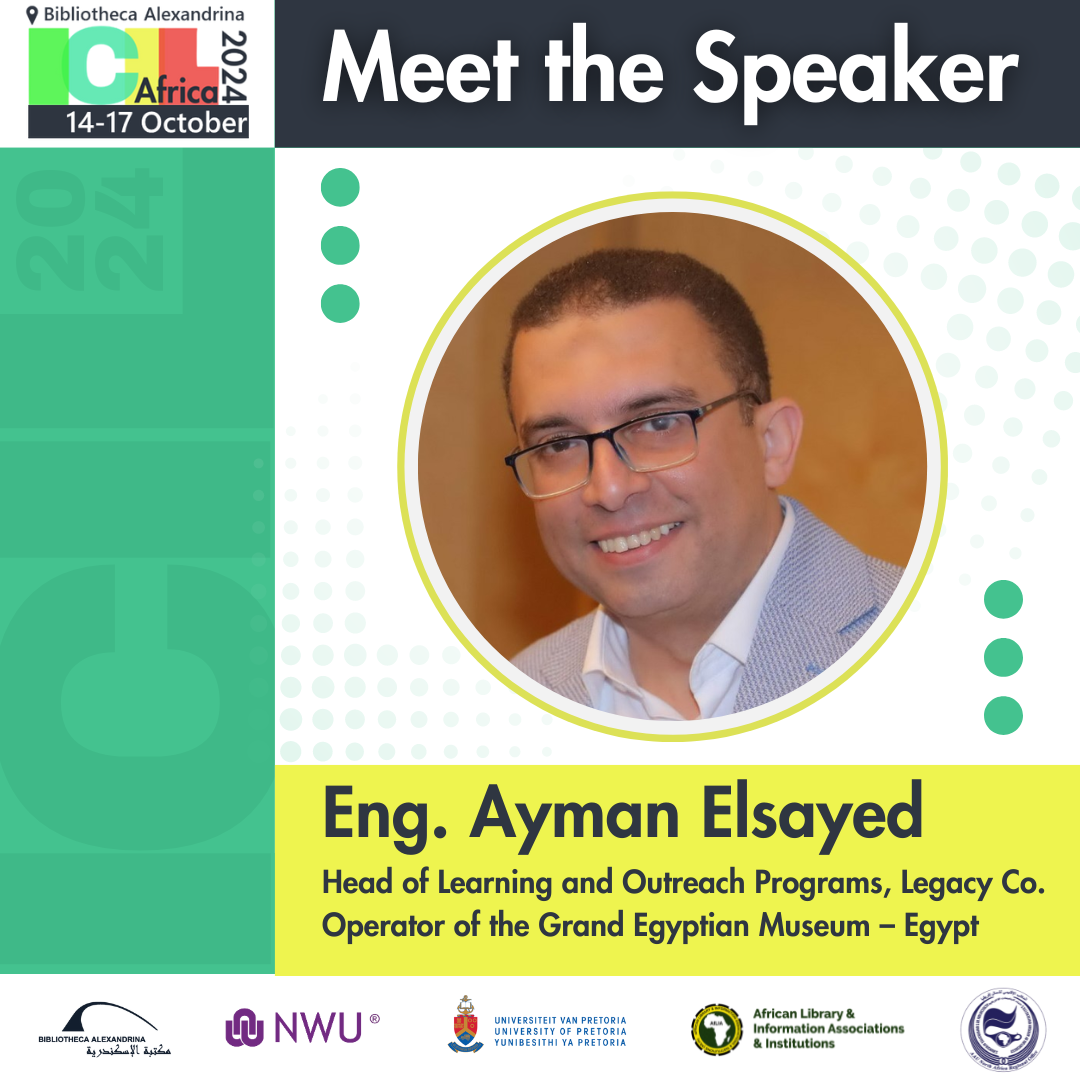
Eng. Ayman Elsayed, is Head of Learning and Outreach Programs at Legacy Co., Operator of the Grand Egyptian Museum (GEM). He got his Bachelor degree of Communication Engineering from Alexandria University, and a Master’s degree in Business Administration from the Arab Academy of Science and Technology. His experience in managing informal educational programs has developed over 20 years through leading the Planetarium Science Center, supervising educational activities, dedicated to children and the public at large. He moved to the GEM in 2022 to establish and supervise the educational component of this great national project. Plus, his duties, Ayman is an advisory board member of the Smithsonian Science Education Center. He served as a member of the National Council of Culture and Knowledge from 2018-2021, advisory board member of the Association of Science and Technology Centers (ASTC) magazine “Dimensions”, plus multiple national committees related to the informal education field. He is the founding chair of Compete NGO, an Egyptian foundation dedicated to youth development.
Author 3
Mr. Amr Abdelnasser
, Egypt.
Biography

Amr Abdelnasser is a dedicated professional at the intersection of exhibitions, heritage management, and innovation. With a background in cultural studies and a passion for preserving heritage, Amr brings a unique blend of creativity and strategic thinking to his work. As an exhibitions specialist, Amr has curated impactful exhibitions that tell compelling stories and engage diverse audiences. With an attention to detail and an ability to weave together historical narratives have resulted in memorable experiences for museum visitors. He employs innovative approaches to conservation and sustainability, ensuring that heritage resources remain accessible and relevant in a rapidly changing world.
Title of the 4th Presentation
Information literacy programs in libraries and their importance in developing digital information awareness trends for societies in the age of artificial intelligence and its challenges: Public libraries in the United Arab Emirates as a model (Download the presentation)
Abstract :
The current study comes within its theoretical framework to explain the nature of information culture, the international and Arab programs that represent it, and its importance in developing the knowledge society. The study then introduces the technological developments of the era and its tools, and shows the extent of the spread of the use of these tools among knowledge societies, and controlling the positive and negative repercussions, from In order to preserve human creativity and thinking while dealing with these tools, through [learning about artificial intelligence tools, their uses, and classifications - identifying what is behind the tool, and the nature of its work: inputs, processes, outputs], while establishing controls for the safe use of the tools on various levels. Aspects.
The study then covers, within its practical framework, a field survey of public libraries in the United Arab Emirates with the aim of identifying the extent to which these libraries support the provision of programs to develop the levels of information literacy in their societies, in order to control and strengthen the strengths, or identify the weak points and address them, using the field study approach. Using the following data collection tools: observation, scientific questionnaire, the study then ends with a proposal for an integrated training program for information culture based on international standards, and considering the technical requirements of the era in our Arab world, in order to form and build a contemporary generation capable of dealing with the technological developments of the era and its tools, Correctly, intelligently, and consciously.
Author 1
Dr. Mahmoud Mohamed Abd Allalem, UAE.
Biography:

Dr. Mahmoud was born and raised in the village of Manqatin in Minya Governorate in Upper Egypt in 1992 AD. He graduated from Minya University, Department of Document Sciences, Library and Information Technology, with a very good grade with first class honors. The researcher obtained a master's degree in Arabic Document Management and Electronic Archiving Systems. Thesis title: Arabic Document Management and Electronic Archiving Systems: Al-Majid System for Document Management and Archiving as a Model. He is currently a doctoral researcher on the subject: Methods of Dealing with Document Management Systems with Retention Period Schedules "A Comparative Analytical Study". He is a member of the International Council on Archives (ICA) in Paris. He has been working at the Juma Al Majid Center for Culture and Heritage in Dubai, United Arab Emirates, since 2017 and still is. He has a number of current and future Arab and international projects and initiatives in the field of documents, heritage, and electronic archiving, with a total of 10 years of practical and research experience in the field of documents, documentation, and electronic archiving. He has published scientific research in international peer-reviewed journals.
Author 2
Manal Faisal Alaraj, UAE.
Biography:
Ms. Manal is a graduate of the Department of Library and Information Management at Al-Balqa Applied University. She is diligent in her studies, passionate about creativity, aspiration, and learning all the details related to her specialization, she is keen to develop herself and develop the place to which she works. She has participated in a number of scientific and professional projects in the specialization. For the past 18 years, She has been working at the well-known information institution: [Juma Al Majid Center for Culture and Heritage in Dubai, United Arab Emirates] in the position of [Management of the Gifts and Exchange Department] in the Technical Processing and Warehouses Department. This scientific and professional career has equipped her with multiple experiences that have benefited her in an excellent way in her field, and made her able to manage all aspects related to library management.
Author 3
Ms. Bibi Sareh Masoumi, UAE.
Biography:
Ms. Sareh works at Juma Al Majid Center for Culture and Heritage as a library and information specialist. She performs several tasks as Indexing and classifying books and publications, indexing periodicals and performing Translation tasks from Persian to Arabic.
Title of the 5th Presentation:
Information Literacy as a Predictor for Driving Data Literacy in Academic Library (Download the presentation)
Abstract
In virtually every aspect of human endeavor there is the need for literacy, information literacy in particular to excel in evaluating the sources of data and the appropriate manipulations required. Literacy is the ability to read and write, which is basic through being literate it extends to how an individual can explore other aspects to finding a way to effectively do things. Hence, through literacy is getting it done in the realm of information. Information literacy according to Hisle and Webb (2017) is a set of abilities requiring individuals to recognize when information is needed and have the ability to locate it, evaluate it. and use it effectively. The use of information literacy as a predictor to driving Data Literacy is apt in this era of Data increase and technological advancement. Librarians need information literacy to drive data literacy which is the ability to drive meaningful information from data. It is also the individual's ability to read, understand and leverage data (DataCamp: https://www.datacamp.com )
Descriptive Survey Research design will be adopted for this study and total population of librarians in the five (5) Tertiary institutions in Rivers State, Nigeria will be employed. This study therefore, will showcase the yardstick used in information literacy and to determine the degree of readiness by librarians to embrace data literacy alongside information literacy.
Author 1
Dr.Juliet Chinedu Alex-Nmecha, Nigeria.
Biography

Dr. Juliet C. Alex-Nmecha is a lecturer in the Department of Library and Information Science at University of Port Harcourt, Rivers State, Nigeria. She has published articles in local and international journals, attended and presented papers in Library and Information Science conferences and other conferences related to Education. Dr. AlexNmecha is a member of some professional associations such as Nigerian Library Association (NLA), Librarian Registration Council of Nigeria (LRCN), Association of Women Librarians of Nigeria (AWLIN) where she currently serves as the National Treasurer of the Nigerian Library Association. She is an award winner on the Best Practicing Librarian in Rivers State, Nigeria and Library Services Promotion award winner in Nigerian Library Association, Nigeria. She was the chairperson, Nigerian Library Association, Rivers State Chapter. she took the chapter to an enviable height by winning the best state chapter award for three consecutive years which crowned the state with an ever-green chapter award.
Recordings and Media Coverage:
Watch the recording:
Download the Zoom Recording (Will be available Soon)
Session Photos