Jupiter is the largest planet, and it also has the biggest family of moons in the Solar System. Over 60 moons of Jupiter have been discovered so far, and as exploration continues, astronomers expect the number of Jupiter's moons to be 100!
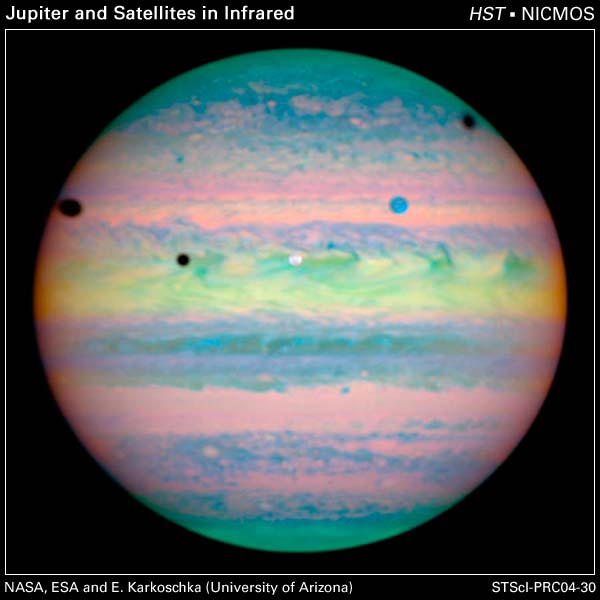
With such an extensive system of moons, the skies of Jupiter may show more than one solar eclipse at a time. Actually, on 28 March 2004, the Hubble Space Telescope imaged the shadows of the largest three moons of Jupiter sweeping across the upper half of the planet!
Figure 1: Three of Jupiter's moons eclipse the Sun on 28 March 2004
This is a rare alignment that occurs only once or twice every decade. At the time the image was obtained, three different solar eclipses were visible in the skies of Jupiter from three different regions on the planet.
Jupiter is a planet of superlatives. The mass of Jupiter is about 2 x 1027 kg, which is over twice the combined mass of the other eight planets, or over three times the mass of Saturn, the second largest planet. Earth's mass is approximately 6 x 1024 kg, or less than 1/300 that of Jupiter.
Our planet is quite small compared to Jupiter. The diameter of Jupiter is nearly 142,000 km, or 11 times that of Earth (12,756 km) and if Jupiter were hollow, there would be space for more than 1,300 Earth-sized planets!
The largest four moons of Jupiter were discovered in January 1610 by the great renaissance scientist Galileo Galilei (1564-1642) (who developed the astronomical telescope), when he began to explore the night sky with a small, self-made telescope.
The four moons are bright enough to be seen with a small telescope, and their motions can be tracked from night-to-night or sometimes from hour-to-hour. They are collectively named the Galilean satellites in honor of their discoverer.
The individual names of the Galilean moons are credited to the German scientist Simon Marius (1573-1624), who named them Io, Europa, Ganymede and Callisto. These are names of characters related to Zeus (the counterpart of Jupiter in Greek mythology).
The sizes of the Galilean satellites are among Jupiter's superlatives: Three are larger than our Moon (which is large compared to the other moons of the Solar System)! Ganymede, with a diameter of 5,262 km is the largest moon in the Solar System, and is even larger than the planet Mercury ( 4,880 km across)! Callisto is only slightly smaller than Mercury, and Io is considerably larger than our Moon!
The Galilean moons are among the most beautiful telescopic sights, and they produce admirable phenomena such as transiting the shimmering disc of Jupiter, traversing their parent planet's shadow, and eclipsing each other.
Further Reading Jupiter Io Europa Ganymede Callisto The Hubble Space Telescope website |