|
BA Podcast with Professor Marcelo Knobel: Celebrating 20 Years of the TWAS-AREP Partnership
|
|

|
|
|
In celebration of the 20th anniversary of the TWAS Arab Regional Partner (TWAS-AREP), the Bibliotheca Alexandrina (BA) has released a featured podcast episode hosting Professor Marcelo Knobel, the Executive Director of The World Academy of Sciences (TWAS).
The episode serves as a high-level reflection on the enduring collaboration between the Bibliotheca Alexandrina and TWAS, which has worked to strengthen scientific capacity across the Arab region for two decades. Throughout the conversation, Professor Knobel shares his vision for the role of science in addressing global challenges and its ability to act as a unifying force in an increasingly complex world.
Key Discussion Points:
- The Role of Science Diplomacy: Prof. Knobel highlights how scientific inquiry serves as a "universal language," enabling international cooperation and bridging geopolitical gaps through shared knowledge.
- Sustainability and Leadership: The discussion emphasizes the urgent need for scientific leadership in the Global South to tackle climate change and achieve the Sustainable Development Goals (SDGs).
- Empowering Young Arab Scientists: A significant portion of the interview is dedicated to early-career researchers in the Arab region, providing a powerful call to action for them to lead regional efforts in innovation and climate resilience.
This milestone episode underscores the commitment of both the Bibliotheca Alexandrina and TWAS to fostering an equitable scientific future.
The full episode is available for viewing on the BA YouTube channel:
|
|
|
|
|
Call for Nominations: UNESCO-Equatorial Guinea International Prize for Research in the Life Sciences
|
|

|
|
|
Deadline for applications: 31 March 2025
The UNESCO-Equatorial Guinea International Prize honors the efforts of individuals, groups of individuals, institutions, or non-governmental organizations (NGOs) that have made outstanding contributions through research in the life sciences. It aims to encourage research and the dissemination of scientific knowledge to address global challenges and enhance human well-being.
Funded by the Republic of Equatorial Guinea, the Prize, which has a monetary value of US$ 300,000, is divided equally among up to three laureates.
Nomination Categories
Nominations are open to:
- Individuals or groups of researchers.
- Scientific institutions and research centers.
- Non-governmental organizations (NGOs) working within the field of life sciences.
🔗 Learn more and apply:
|
|
|
|
|
Opportunity Alert: Seed Grant for New African Principal Investigators
|
|
|
|
|
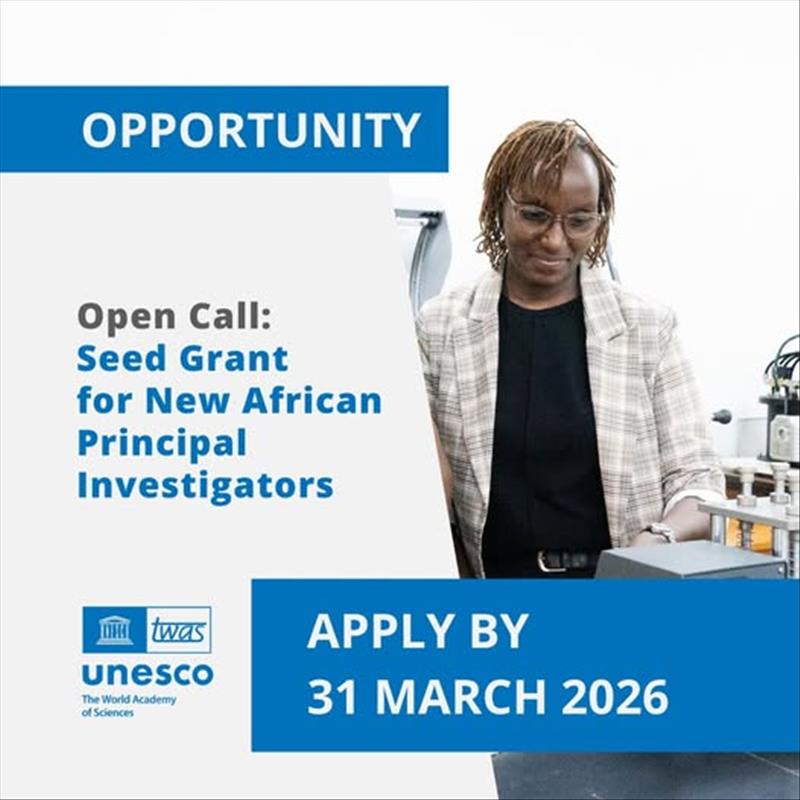
Seed Grant for New African Principal Investigators (SG-NAPI) is now accepting applications for the 2026 cycle. This prestigious program, supported by the German Federal Ministry of Education and Research (BMBF), is designed to empower early-career scientists across Africa by providing the necessary resources to establish independent research labs and launch their own research groups.
The SG-NAPI grant aims to strengthen scientific capacity and foster innovation across the continent. It provides substantial financial support for researchers returning to their home countries after completing their doctoral studies abroad.
- Funding: Up to USD 67,700 for the purchase of scientific equipment and consumables.
- Eligible Disciplines: Agriculture, Physics, Artificial Intelligence, Biotechnology, Fusion, Climate-Neutral Energy, and other related STEM fields.
- Strategic Goal: To support the next generation of research leaders and mitigate "brain drain" by facilitating high-level research within Africa.
Eligibility and Geographic Focus
The program specifically targets scientists from African countries identified as Science and Technology Lagging Countries (STLC). We particularly encourage applications from the following Arab-African countries:
- Sudan, Mauritania, Somalia, Djibouti, and Comoros.
Key Requirements:
- Applicants must have obtained their PhD degree outside their home country within the last five years.
- Applicants must have returned to their home country within the last 36 months or be in the process of returning to a permanent position.
- Applicants must be aged 40 or under.
Application Deadline: 31 March 2026
Inquiries: For specific questions regarding the application process, please contact sgnapi@twas.org.
Apply Online:
|
|
|
|
|
Opportunity Alert: TWAS-DFG Cooperation Visits Program for MENA Researchers
|
|
|
|
|
Application Deadline: 15 April 2026
We are pleased to announce the opening of the TWAS-DFG Cooperation Visits Program, specifically designed for postdoctoral researchers from the MENA region. This initiative, a collaboration between The World Academy of Sciences (TWAS) and the Deutsche Forschungsgemeinschaft (DFG), aims to foster international scientific cooperation by facilitating research stays in Germany.
The program provides early-career researchers with the opportunity to visit a research institute in Germany for up to three months. These visits are intended to help scientists establish long-term collaborations, share expertise, and initiate joint research projects.
Eligibility Criteria
- Location: Must have been living and working in a MENA region country for at least the last five years.
- Academic Level: Must hold a PhD obtained no earlier than 2021.
- Fields: Open to all academic disciplines.
Support for Female Researchers
In a dedicated effort to support gender equity in science, the PhD age limit for female applicants can be extended by two years per child (e.g., if an applicant has two children, the PhD graduation limit can be extended by four years).
Grant Details
- Duration: Maximum of 3 months.
- Timeline: The visit must be undertaken within 12 months of receiving the award.
- Funding: The grant covers international travel and provides a monthly subsistence allowance for the duration of the stay.
Full Details & Application Link:
|
|
|
|
|
TWAS-DFG Cooperation Visits Programme - SSA: deadline 15 April 2026
|
|
|
|
The TWAS-DFG Cooperation Visits Programme provides postdoctoral researchers who have obtained their PhD not earlier than 2021 and have been living and working for at least the last five years in sub-Saharan Africa <https://twas.org/sub-saharan-african-countries-0> with the opportunity to make a 'Cooperation Visit' to an institute in Germany.
For female applicants the year limit for the PhD can be extended by two years per child.
Such visits will have a duration of no more than three months and must be undertaken within 12 months of the award.
The deadline for submission is 15 April 2026.
All information, including the online application form, is available here:
|
|
|