ICIL-Africa 2024 - 16 October 2024
Scientific Session 1 – Chairperson: Dr. Ahmed Mansour
Lecture Hall - 13:00 pm – 15:00 pm
Meet the Scientific Session Chairperson

Dr. Ahmed Mansour is the Director of the Bibliotheca Alexandrina's Writing and Scripts Center. He is an Egyptologist by study, researcher in the history of Arabic printing and in the history of writing by work and research. He has got his PhD from Alexandria University. In addition, He has obtained two master degrees; one from Alexandria University and one from Turin University (Level II Master). He has joined several archaeological missions: Luxor (Harwa Tomb 2011-2012), in Alexandria (Nelson Island 2011-2012), and visiting member to Wadi el-Jarf archaeological mission and Ain el-Sukhna mission at the Red Sea (2011-2013). — with African Library & Information Associations and Institutions - AfLIA and Association of African Universities North Africa Regional Office, NARO. In 2005, he published The Bulaq Press monograph for he was awarded the Incentive State Award in Social Science in 2008. He was also the recipient, in 2006, of an award from the Kuwait Fund for Arab Economic Development for the best translated book form French into Arabic. histoire de l'écriture de l'idéogramme au multimédia. During 2016-2017 he is been invited as a founding member the International Association of Printing Museums (IAPM) in Cheongju, South Korea. From 2018- 2020 he is officially nominated by Bibliotheca Alexandrina to be a founding and a board member of the International Association of Printing Museums (IAPM) in Cheongju, South Korea. In 2022, he has been a vising scholar at Egypt Exploration Society (EES) in London, where he has been visiting many important museums and archaeological sites, he is now working on the preservation and study of the archives of Egyptian pioneers in Egyptology such as Ahmed Pasha Kamal. In addition, he is focusing in using the digital technologies in the preservation of heritage
Title of the 1st Presentation
Trends of students of the Faculty of Arts in the departments of libraries and information and media at Alexandria University towards the use of artificial intelligence applications: Chat GPT as a model. (Download the presentation)
Abstract
The Use of Chat GPT Artificial Intelligence Applications by Students of the Faculty of Arts at Alexandria University, Departments of Libraries and Information, and Media: A Case Study
-Introduction:
Artificial intelligence has made its mark on all sciences in the current era; specifically, in the past two years, numerous applications of artificial intelligence have emerged. One of the most important and well-known applications is Chat GPT, which has become one of the most important research and study tools for researchers, programmers, and others.
-Research Problem:
The researcher noticed the students' inclination to use Chat GPT during her teaching sessions to assist them in preparing their academic assignments. Therefore, it necessitated studying their attitudes towards this usage for evaluation.
-Research Questions:
To achieve the study's objectives, the researcher seeks to answer the following questions:
What is the extent of awareness among the students regarding the application of Chat GPT and its potentials and benefits for students and researchers?
Do the students follow the correct method in research to obtain the best results using this application?
What are the criteria for evaluating research results through Chat GPT?
-Research Methodology:
To answer the research questions and achieve its objectives, the researcher relies on the descriptive field methodology.
-Study Objectives:
The study aims to achieve the following:
To identify the extent of reliance of students of the Faculty of Arts, Departments of Libraries and Information, and Media at Alexandria University on Chat GPT in performing academic assignments.
To evaluate their efficiency in using it to achieve accurate and reliable research results in their respective fields of specialization and in the correct language.
To assess the students' efficiency in evaluating the results they obtain when using Chat GPT.
-Study Significance:
The study derives its significance from the following:
The importance of raising awareness about the application of Chat GPT and its potentials for students and researchers.
The importance of directing university professors to guide their students to use Chat GPT effectively in the educational process and to achieve accurate research results in a correct language with reliable sources.
-Study Tools:
The study relies on the following tools:
Questionnaires directed to the students under study.
Author 1
Dr. Sara Mahmoud Bondoka, Egypt.
Biography

Dr. Sara is currently an Instructor at the library and information science department with 14 years of experience at library and information science, faculty of arts, Alexandria university. She Graduated from library and information science faculty of arts, Alexandria university 2009. She had her Master degree in 2015 and her PHD in 2018. She delivered several Workshops & sessions on using the AI in libraries in 2024. She has several certificates, some of which are; Certification of conferences organization, Certification of morals of the scientific research and Certification of quality standards in the educational process.
Title of the 2nd Presentation:
Intégration de l’utilisation de l’Identifiant ORCID dans la formation des chercheurs à la maîtrise de l’information dans les institutions académiques et de recherche publiques en Côte d’Ivoire. (Download the presentation)
Abstract
With a rate of 3%, scientific production in Africa remains poorly visible, accessible and reusable given the difficulties linked to the inadequacies of policies and strategies for disseminating scientific knowledge. This concern, at the heart of the issue of innovation and development, has led to certain initiatives including the creation and implementation of the ORCID-CI consortium (2023-2024) as part of the Global Participation Funds (GPF). The partial results of the project, led by the Virtual University of Côte d'Ivoire (UVCI), mark the interest in integrating the use of ORCID ID into the digital skills needed and information literacy is now applied to all the entire open research process, the mechanisms for producing and disseminating outputs and data.
Out of more than 700 researchers and some librarians trained in the issues and interests of using the ORCID identifier, 169 participants responded to the evaluation survey: 21 doctoral students (12.4%), 115 teacher-researchers (68 %) 24 researchers (14.2%) and 7 librarians (4.2%). The results are confirmed with 98% the expression of the usefulness of the training, and 75% expression of the desire for further development. Beyond these results, it emerges the interest in integrating the use of the ORCID Identifier to improve information skills, the visibility of researchers, the discoverability of their work and research outputs in developing countries with a view to contribute to inclusion, open collaboration and open research. Provided by a team of three trainers from different specialties, artificial intelligence, documentation and network systems, information literacy training, essential, aims transdisciplinarity in a context where science opens up to the participation of non-scientists to boost and innovate research practices.
Author 1
Dr. OUATTARA-COULIBALY CECILE, Côte d’Ivoire
Biography

Dr. Cécile is Coordinator of the activities of the Virtual Library of Higher Education and Scientific Research in Côte d'Ivoire, Cécile is in charge of scientific commissions at the Virtual University in Côte d'Ivoire. A passionate trainer for more than twenty years, information literacy, Cecile's professional practices and research's area, constitutes a key to success for learners, teachers and researchers. It is a dynamic engine for lifelong learning, creativity, openness and networking. The information literacy skills have completely immersed me in the world of research, open access and open science materialized since 2018 with the Open Access Week Côte d'Ivoire initiative established. Information literacy skills are essential for survival in a digitalized academic and research world, and for the implementation of the UNESCO open science recommendation signed since 2021.
Title of the 3rd Presentation:
Remote Patient Monitoring for Therapeutic Unit Implementation of a Pilot Model (Download the presentation)
Abstract
Information and communication technology (ICT) has played a pivotal role in healthcare sector. wireless communication and wearable sensor technology, in particular have caught more attention of the healthcare sector[2]. As it allows for real-time healthcare monitoring systems where timely diagnosis and treatment can go a long way in reducing unnecessary loss of lives primarily due to negligence of healthcare givers and due to low nurse-to-patient ratio[1],[3]. Therefore, this study aims to evaluate the effectiveness of the remote patient monitoring (RPM) program for hemophilic children management in Egypt., such evaluation will allow, indirectly, to validate the feasibility of (RPM) system in terms of lack of data and patient acceptance. This study was conducted in the Regional Blood Transfusion Center (RBTC) at the Therapeutic Unit, Alexandria. Thereafter, a methodology is applied to evaluate the performance of the program and health informatics services at RBTC. Furthermore, an Applied approach was conducted to improve patient experience, medication compliance, and reduce hospital readmission. It was concluded that RPM monitors wirelessly patients’ physiological parameters in real-time and transmits the data to the Electronic Medical Record in real-time, providing text message alerts to a doctor upon detection of abnormal patient readings. Additionally, it was concluded that home therapy allows immediate optimal early treatment, resulting in decreasing pain, dysfunction, and long-term disability.
Author 1
Dr. Rania Mohell
, Egypt.
Biography

Dr. Rania has a Ph.D. in health informatics and M.Sc. in information technology from Alexandria University. Studied Information Technology and Information Science in the faculty of Arts – Alexandria University as an undergraduate. and have maintained a career in the IT field. Current role is IT Specialist at the Alexandria regional transfusion blood center. In addition, to my work as specialist IT services at Alexandria plasma fractionation center in Egypt. Work background as IT Specialist with over 6 years of experience at Egyptian ministry of health projects. Lead several IT transformation projects throughout my career. Most recently, I led commissioning of the IT infrastructure, Data center and systems for entirely ancillary clinical departments such as Blood banks, Therapeutic unit, electronic health records for hematology patients and secure supply chain in pharmaceutical. Moreover, works for software’s development as a back-end developer that enables service to provide to efficiently deliver high quality in digital health. This is in addition to my academic role in postgraduate programs Lecturer in health Informatics at Sadat Academy for Management Science in Egypt. I am also having a several scientific publications in health informatics and health IT.
Title of the 4th Presentation
Comment l’intelligence artificielle va-t-elle révolutionner la profession de bibliothécaire ? (Download the presentation)
Abstract :
The end of 2022 witnessed the advent of an advanced artificial intelligence developed by OpenAI. This sophisticated chatbot has democratized artificial intelligence, heralding what some consider the dawn of Web 4.0. With its capability to perform a wide array of tasks efficiently and effectively in a short span of time, there is a growing fear among humans regarding job security. Indeed, algorithms may pose a significant threat to various professions. As some jobs may vanish while others undergo transformation, what is the fate of the librarian profession? Will artificial intelligence lead to the eradication of this vocation, or will it revolutionize the role of librarians? This pressing concern generates substantial reflection and interest within the documentation field. This article delves into the implications of artificial intelligence for librarians.
Author 1
Mr.Atman MAMADOU BOUBA, Benin.
Biography:
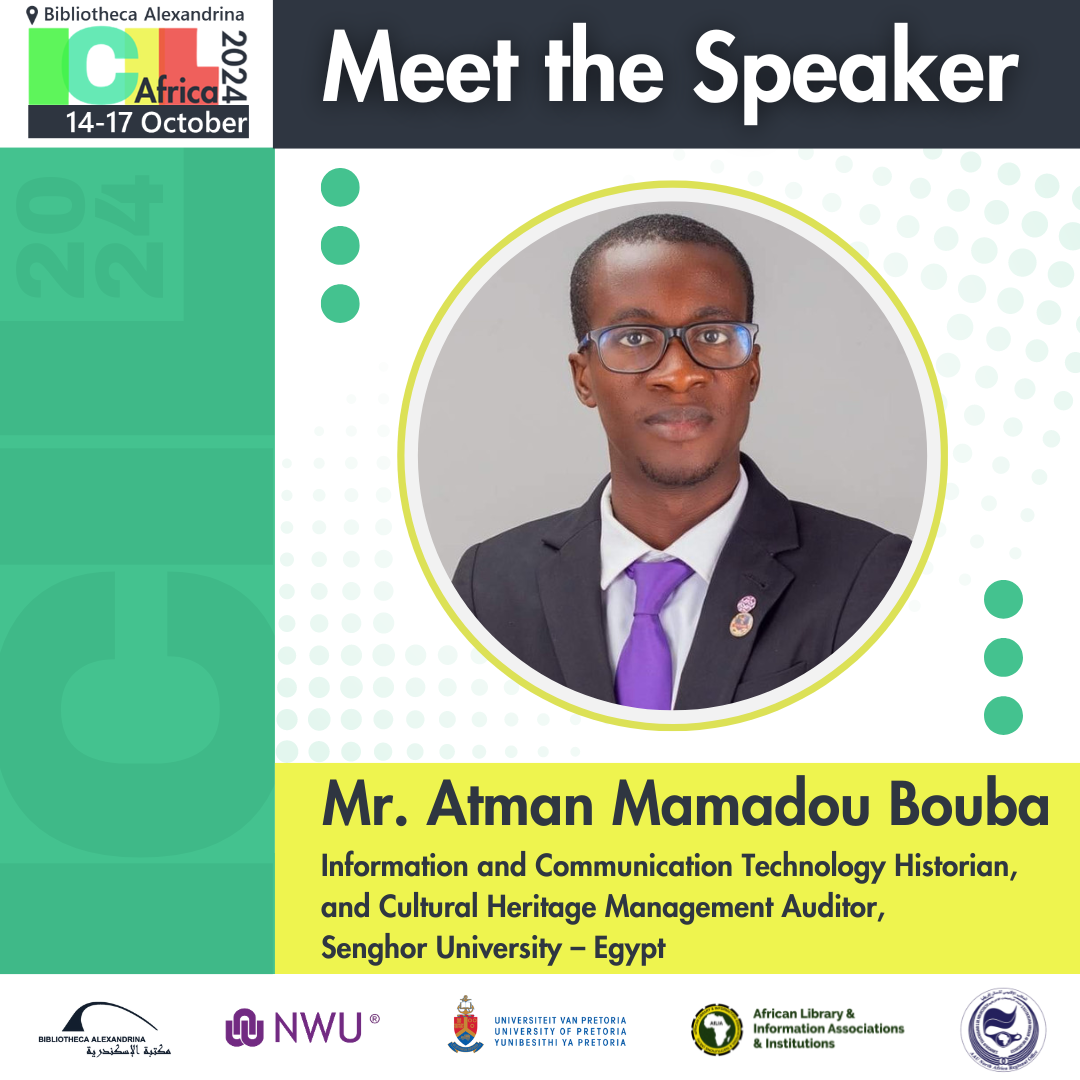
Trained as a historian, Atman MAMADOU BOUBA is a digital communication consultant. Passionate about digital technology, ICTs, and blogging, he has been a blogger on the French-speaking platform Mondoblog of RFI since 2014. In addition to a certificate in web writing techniques obtained in Dakar through this platform, he also holds a certificate in web journalism, a training provided by Rue89 and CFI Media. He is equally passionate about web photography, video, community management, and digital communication, and he shares his knowledge through introductory blogging workshops.
He is deeply committed to democratic good governance and harbors a strong patriotic love for his beloved homeland, Benin. This love was demonstrated through his active involvement in the 2016 Benin Votes project (#vote229), a citizen watchdog initiative during the March 2016 presidential election aimed at ensuring a transparent and peaceful vote, in collaboration with the Association of Bloggers of Benin. He served as a web editor for the electoral platform of Benin’s Civil Society Organizations (www.vote229.org).
Atman is an advocate for democratic good governance, freedom of expression, the right to access information, and the respect for human rights, among others.
He is also the coordinator of the platform www.citoyen229.org, a citizen watchdog initiative in the digital age.
Title of the 5th Presentation:
The Impact of AI-Generated "Hallucinations" on University Researchers. (Download the presentation)
Abstract
Since we live in the era of the information revolution, finding trusted and accurate information takes time and effort made students and researchers aim to find an easier way. Generative AI (Artificial Intelligence) tools offer an easy solution for accessing the required information easily and accessible; however, these tools rely on vast datasets to predict statistically probable outputs, not guaranteed accuracy. This can lead to misinformation, factual errors, biases, and fabricated content, which is termed "hallucinations."
The research problem focuses on the challenges of detecting these AI hallucinations, the main issue for all users of AI technologies.
The goal of this study is to develop accessible and analytical methods to effectively assess the accuracy of content generated by AI tools. This involves the approach to understanding the biases and errors associated with AI outputs.
Methodologically, the study will employ a mixed-methods approach, combining quantitative analyses of AI tool accuracy with collecting qualitative data via survey of users across a range of fields to gather insights on the impact of AI hallucinations.
The expected results of this research are to reveal the pitfalls that researchers might run into when relying on AI technology for their work. Additionally, the findings will contribute significantly to information literacy programs, by advocating for the including of AI tool assessments within the broader information literacy curriculum and equipping users with the skills to critically evaluate AI-generated content.
Author 1
Hend Kamel, Egypt.
Biography

Hend Kamel, Subject Librarian at New Giza University, researches the impact of information technology on academic research practices. Her current work focuses on information literacy skills needed to evaluate AI-generated information.
Title of the 6th Presentation:
Blending in & Standing Out, a quick glance on positioning the library and some IL and AI activities. (Download the presentation)
Abstract
As AI activities in relation to information literacy starts to expand causing an urge for libraries to blend in and stand out. This presentation gives a quick glance on the relation with African archive and library institutions within VID Specialized University in Norway and describing some past and ongoing joint Information literacy activities. As well as highlighting the work done with book launches and Library events to connect with academic staff on different levels.
Inspired by both David Lenkes and Lorcan Dempsey, we often refer to this as staying "In the loop" and "creating community". Positioning ourselves in this manner we find can help provide students and staff with the right information at the right time.
Author 1
Ms. Live Rasmussen, Norway.
Biography
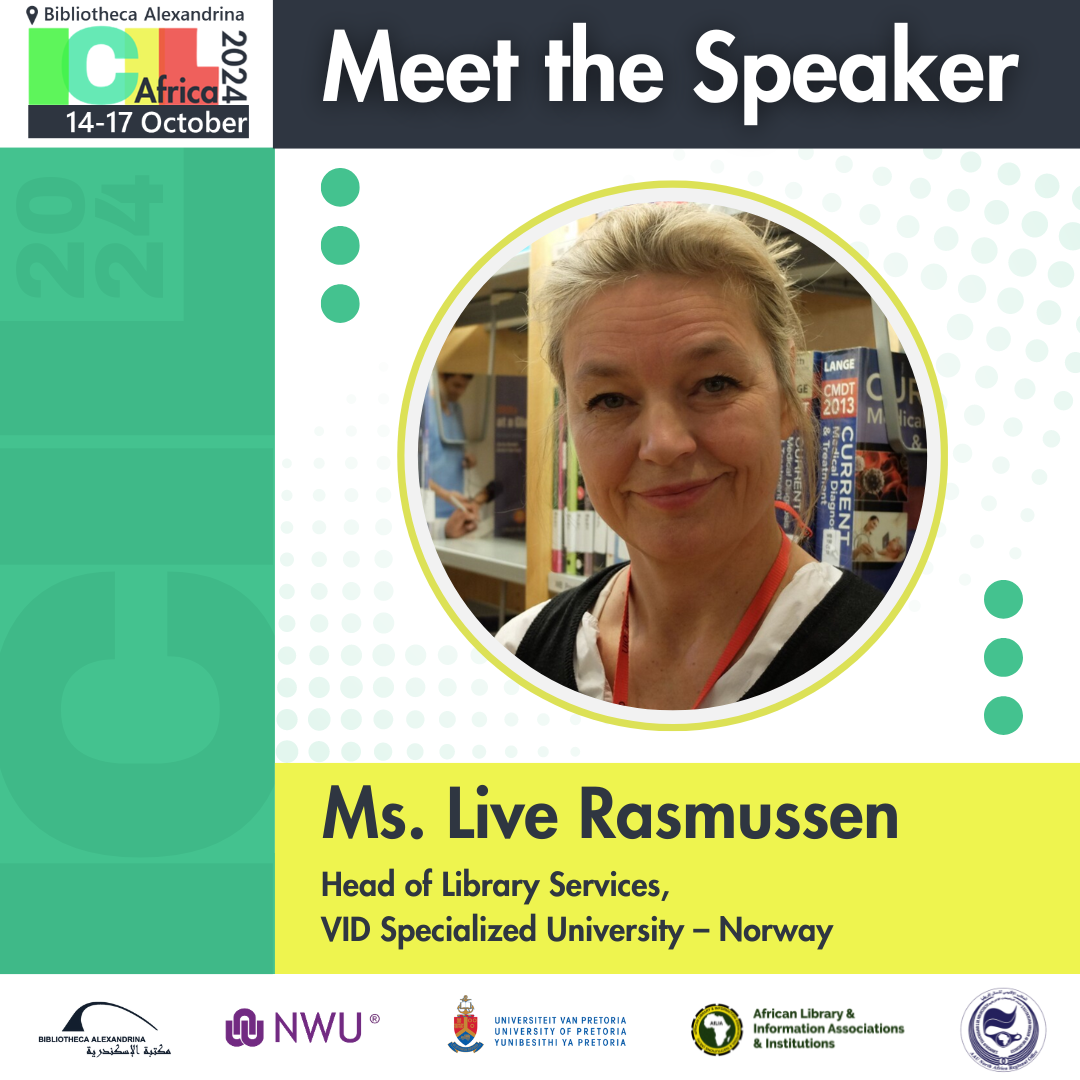
Ms. Live Ramussen is Library Director, Division for Library, Research Data Management and Historical Archiveat at VID vitenskapelige høgskole, Norway. She is an Experienced leader/manager with a demonstrated history of working in higher education and libraries in diverse roles. she is Skilled in human resource development, change management and strategic/organizational development. Her MBA from UCL focused on Higher Education & Higher Education Administration.
Recordings and Media Coverage:
Watch the Recording:
Download the Zoom Recording (Will be available Soon)
Session Photos